— Genetic Lineage —
Norman Y-DNA (Cotentin)
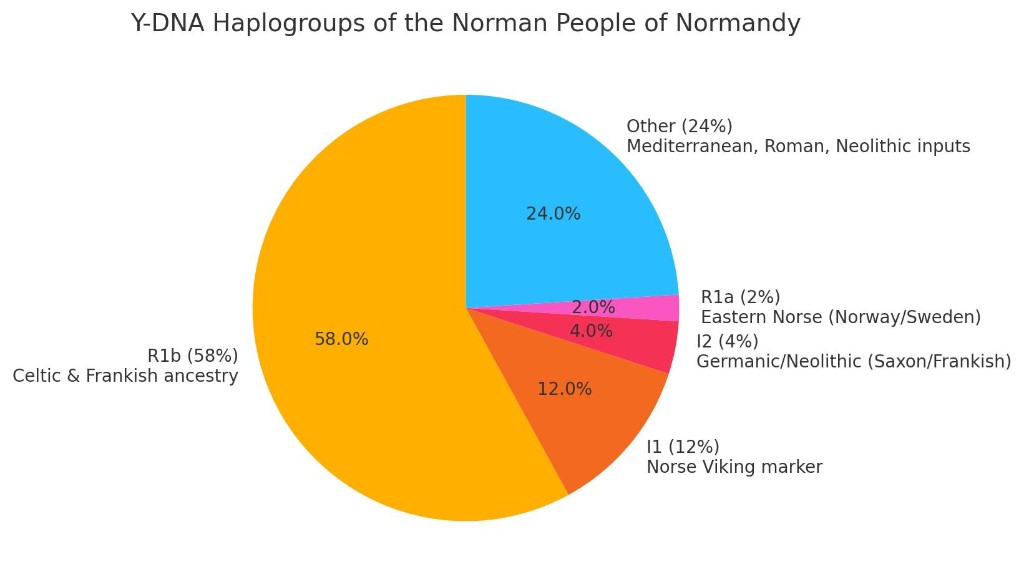
Y-DNA haplogroups of the Norman people of Normandy
The hybrid origin story
Medieval Normandy arose where Norse settlers and their allies met a long-established Gallo-Roman world of Celtic- and Frankish-descended communities. Y-chromosome haplogroups (father-to-son lineages) are one narrow lens on that encounter: they do not describe full ancestry, language, or identity. Still, the mix described in Norman history—deep western European R1b versus northern European I1 (and smaller Norse-leaning R1a)**—shows up clearly in regional surveys that contrast Normandy with much of inland France.
Haplogroup R1: Celtic and Frankish roots (with possible Norse overlap)
R1b — the Atlantic / Frankish substrate
R1b is the dominant major lineage across much of western Europe. In broad-brush narratives it tracks Bronze Age steppe-related expansions that later saturate Celtic- and Germanic-speaking communities; in Normandy it is often read as the pre-Viking “substrate” (Gaulish, Romanized, Frankish), because high R1b is unremarkable in France overall. In a widely cited Cotentin-focused tally of 89 men with long local surnames, about 58% carried R1b — compatible with the idea that most patrilines remained “local” even after political Viking takeover. Some R1b subclades also occur in Scandinavia, so not every R1b lineage in Normandy must be “indigenous Gallo-Roman” without deeper subclade work—interpretation belongs with the tester and primary phylogenies (ISOGG, YFull, papers).
R1a — a scarcer eastern Norse signal
R1a is more concentrated toward eastern Scandinavia and the Baltic–Slavic world than typical Danish coastal baselines. In the same Cotentin-style outreach summaries, R1a might appear only around ~2% (order of two individuals in an ~89-person list). Authors sometimes argue this pattern fits greater Danish than Norwegian immigration into Normandy, because Norwegian coastal populations often carry more R1a in modern sampling than Danes—but this is interpretive, not proof of individual origins. See population-genetics summaries of Viking-period mobility, e.g. Margaryan et al., *Nature* 2020.
Haplogroup I: Norse and North Sea Germanic footprints
I1 — the classic northern / Viking-associated marker
I1 peaks in modern Scandinavia and appears at high frequency in many Viking-aDNA male cohorts; it is the haplogroup lay readers most often associate with “Viking Y-DNA.” In the Cotentin tally, I1 lands near ~12%—modest versus modern Norway or Denmark, but far above typical French interiors, which is why regional genetic-genealogy writers treat Cotentin and nearby coasts as outliers worth discussing alongside dense Norse toponymy. That contrast (Normandy vs. Brittany in some write-ups—higher I1 in Norman coast versus very I1-poor Brittany in the same kind of storytelling) is illustrative, not a controlled sampling comparison.
I2 — Saxon, Frankish, older north European layers
I2 branches appear at low percentages in many northern European surveys. In Normandy, a few percent I2 is often bundled with wider “North Sea / Germanic” stories (Saxons, Franks, some Scandinavian outliers) rather than as a single migration event.
“Other” Mediterranean, Neolithic, and rare outliers
The remaining quarter of the simplified Cotentin pie—here ~24% pooled as Other—reflects that France, like all of western Europe, carries Neolithic farmer, Mediterranean, and eastern Y-lineages that are not specifically “Viking.” Typical teaching examples include E1b, G2, J1, J2, and very rare N1c or Q lineages that need case-by-case documentation. These haplogroups can predate the Viking Age by millennia or arrive through Roman connectivity, later trade, or small elite mobility—not automatically “recent immigrants” in the Viking centuries.
Irish connection (R1b-M222 as a case study)
Some Cotentin lists note R1b-M222, a subclade heavily concentrated in northwestern Ireland in modern databases. Historians and genetic genealogists sometimes link that signal to Hiberno-Norse networks (movement from the Irish Sea into the Channel) rather than purely “direct Norway → Cotentin” jumps. It is a reminder that Viking Age migration graphs have hub cities and sea highways, not only national labels.
Ancient DNA, elite burials, and the limits of celebrity testing
Medieval Norman elite aDNA from documented tombs remains patchy in public literature; attempted work on ducal remains has often hit technical or authentication barriers—a frequent problem for medieval DNA. Rollo’s own Y-haplogroup should therefore be treated as unknown in responsible summaries until a formal, peer-reviewed publication exists.
Modern Cotentin surveys are easier to discuss because they report concrete haplogroup tallies—but they still reflect who tested and how participants were recruited, not a statistical census of tenth-century fathers.
Normans abroad
After 1066 and Norman Mediterranean expansion, detecting “the Norman haplogroup” abroad is harder than it sounds: many Norman knights could already carry Y-lineages indistinguishable from neighbors (shared R1b or I pools across the Channel and the North Sea). Sicily and Italy show interesting geographic clines in haplogroup I that authors sometimes tie to northwestern European inputs including Normans—but those arguments are multicausal (Lombards, Greeks, earlier migrants).
What the pie is really saying
In teaching language, Norman Y-DNA from Cotentin-flavored surveys looks like mostly western European R1b, with a visible I1 (and smaller I2 / R1a) Scandinavian-associated component, and a sizeable “everything else” bucket that keeps Mediterranean and deep-time European diversity in the picture. That pattern fits a society formed by political Norse leadership and mixed marriage networks atop an older Frankish–Gallic population, not a wholesale replacement of male-line ancestors.
Sources and further reading
- Société historique Hag’Dik — *Sur la trace génétique des Vikings en Normandie : l’ADN cotentinois parle*
- Wikipédia — *Colonisation de la Normandie* (historical framing of settlement)
- Margaryan *et al.* — Population genomics of the Viking world (aDNA context)
- English Wikipedia — *Vikings* (general orientation; not a primary genetic source)
- Wikipedia — *Genetic history of Italy* (illustrative for south Italian clines often discussed beside Norman history)
For Norman Atlas interpretation rules, see the lineage citations policy in the Journal.